
Welcome to GroundZero EV: Your Electric Vehicle Journey Starts Here. So, you’re thinking about an electric vehicle? That’s fantastic! One of the first things new EV owners often get curious (or a little confused) about is how charging actually works. You’ll hear terms like “charger” and “adapter,” and it can seem like a lot. Let’s break down the basics so you can charge your EV with confidence!
What is an EV “Charger”? (It’s not quite what you think!)
This might surprise you: The actual “charger” that converts electricity from the grid into a form your EV’s battery can store is built inside your electric vehicle. Yes, that box on your garage wall or the tall public station you see isn’t the charger itself, it’s called Electric Vehicle Supply Equipment (EVSE).
Think of an EVSE as a very smart, high-tech power cord. Its job is to safely deliver electricity from your home’s electrical system or a public charging station to your car. It communicates with your car to make sure everything is safe and that your car gets the right amount of power.
EVSEs come in different “levels” that determine how fast they can charge your car:
- Level 1 Charging: This is the slowest but most basic. It’s simply plugging your EV into a standard wall outlet (like the one for your phone or lamp) using the cable that usually comes with your car. It’s great for topping up overnight if you don’t drive much, adding about 3-5 miles of range per hour.
- Level 2 Charging: This is much faster and uses a more powerful 240-volt outlet (like for a clothes dryer). You’ll typically install a Level 2 EVSE at home, and they’re also common at workplaces and public spots. They can add 20-40 miles of range per hour, meaning a full charge overnight for most EVs.
- DC Fast Charging (Level 3): This is the speed demon of EV charging! You’ll find these powerful stations along highways and at major shopping centers. They convert electricity before it even reaches your car, delivering power directly to the battery much faster, often adding 80% charge in 20-45 minutes. You can’t install these at home.

So, What’s an EV Adapter?
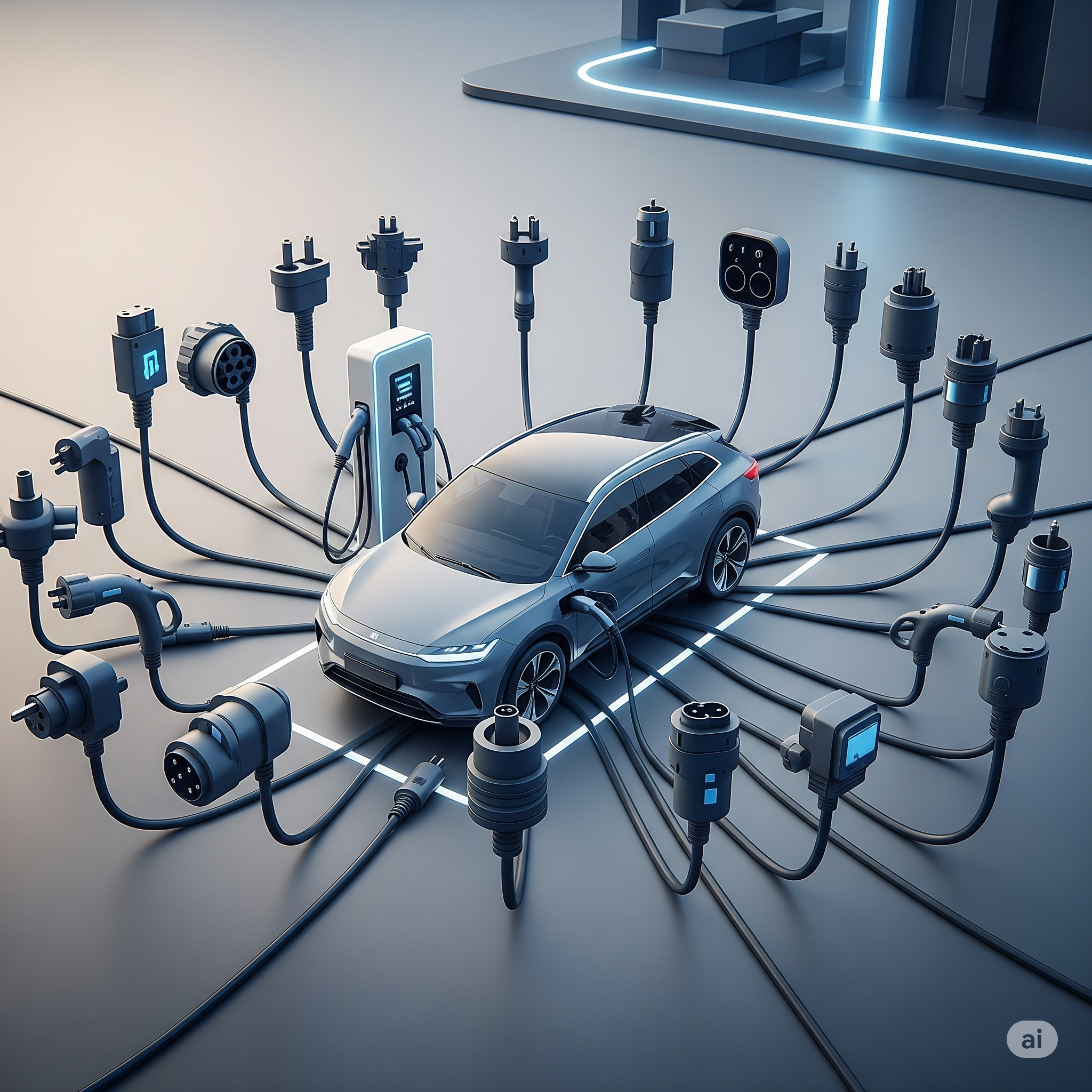
An EV adapter is a handy little device that allows your electric vehicle to connect to a charging station that has a different type of plug than your car’s charging port.
Think of it like the travel adapters you use for electronics when you go to a different country. Your phone charger might have a two-prong plug, but if you’re in Europe, you need an adapter to fit into their wall outlets. EV adapters work similarly, bridging the gap between different “connector types.”
There are a few main connector types you might encounter:
- J1772 (Type 1): This is the most common plug for Level 1 and Level 2 charging in North America for most EVs (non-Tesla).
- NACS (North American Charging Standard / Tesla Connector): Originally exclusive to Tesla, many other automakers are now adopting this sleek connector. It can handle all three charging levels.
- CCS (Combined Charging System): This is the go-to standard for DC Fast Charging for most non-Tesla EVs in North America. It essentially builds on the J1772 plug with two extra pins for fast charging.
- CHAdeMO: An older DC Fast Charging standard, more common on older EVs and certain Japanese models. It’s less common on new EVs in North America now.
Why would you need an adapter?
Let’s say you have a non-Tesla EV with a J1772 port for Level 2 charging, but you want to charge at a friend’s house who has a Tesla Wall Connector (NACS). You’d need a J1772-to-NACS adapter to make that connection. Or, if you have a Tesla and want to use a public DC Fast Charger that only has a CCS plug, you’d need a Tesla-to-CCS adapter.
Important Note: Always use adapters from reputable manufacturers, ideally ones recommended or supplied by your vehicle’s manufacturer. Using unapproved adapters can be unsafe and potentially damage your car or the charging equipment. And remember, an AC adapter (for Level 1/2) is not designed for a DC Fast Charger, and vice versa!
The Big Picture: Simplicity in Practice
While the terms might seem technical at first, the actual experience of charging an EV is usually very simple:
- At Home: Plug in your car when you get home, just like you plug in your phone.
- On the Go (Public Charging): Locate a compatible charger using an app, plug in, and let your car do its thing. If the charger’s plug doesn’t quite match, an approved adapter can often save the day!
Understanding these basics of EV “chargers” (EVSEs) and adapters will empower you to navigate the exciting world of electric vehicle ownership with ease. Your electric journey starts here, and we’re here to guide you every step of the way!